Longevity Research Peptides • Mitochondrial Research Peptides
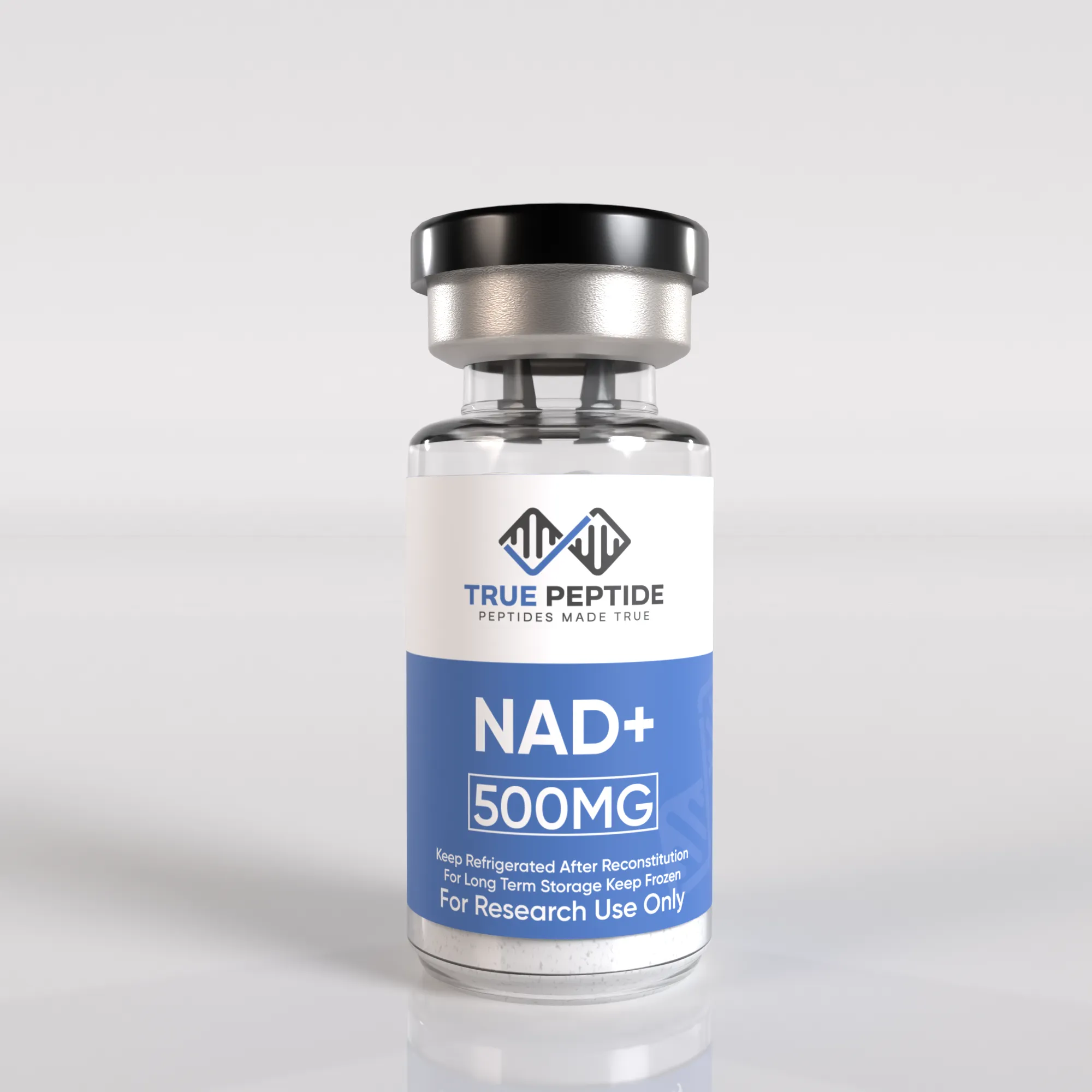
NAD+ 500mg
$62.00$62.00
● In stock
NAD+ (Nicotinamide Adenine Dinucleotide) is an endogenous coenzyme composed of two nucleotides — adenosine and nicotinamide riboside — joined through a pyrophosphate bridge. Supplied as a ≥99% HPLC-UV purity lyophilized powder, 500 mg labeled size, with identity confirmed by LC-MS ([M+H]⁺ observed at m/z 663.700). Lot-specific Certificate of Analysis from Freedom Diagnostics (USA). Research Use Only — not for human or veterinary use.
Compound Name
NAD+
Full Chemical Name
Nicotinamide Adenine Dinucleotide (oxidized form)
Synonyms / Also Known As
NAD; NAD plus; β-NAD⁺; β-Nicotinamide adenine dinucleotide; oxidized nicotinamide adenine dinucleotide; DPN (diphosphopyridine nucleotide, historical name); coenzyme I (historical name)
CAS Number
53-84-9
Molecular Formula
C₂₁H₂₇N₇O₁₄P₂ (as the neutral zwitterion)
Molecular Weight
~663.43 g/mol (free acid)
MS Confirmation on COA
[M+H]⁺ observed at m/z 663.700; [M+2H]²⁺ observed at m/z 332.600 (convergent identity confirmation across two charge states)
Structure Type
Dinucleotide (adenosine 5'-monophosphate + nicotinamide mononucleotide, joined via pyrophosphate bridge)
Component Nucleotides
Adenosine monophosphate (AMP) moiety + nicotinamide mononucleotide (NMN) moiety
Oxidation State
Oxidized form (NAD⁺); not the reduced form NADH
Compound Class
Endogenous pyridine dinucleotide coenzyme referenced in biochemistry research
Product Type
Coenzyme (endogenous metabolic cofactor) — not a peptide, not a designed small-molecule drug
Purity
99.57% (HPLC-UV) — per COA lot NAD5-032-TPL
Identity Confirmation
Confirmed by LC-MS (per lot COA)
Appearance
White lyophilized powder
Solubility
Water-soluble
Hygroscopicity
NAD+ is hygroscopic and moisture-sensitive; strict moisture protection is essential
Available Sizes
500mg
Net Content per Vial (COA)
521.11 mg
Storage (lyophilized)
-20°C, sealed, protected from light and moisture; NAD+ can hydrolyze on prolonged storage at room temperature
Storage (reconstituted)
Aqueous solutions of NAD+ are less stable than the lyophilized form; use freshly prepared solutions where possible, aliquot and freeze -20°C for longer-term storage, avoid repeated freeze-thaw
Synthesis
Manufactured to research-grade specification
Testing Lab
Freedom Diagnostics, USA
Principal Chemist (on COA)
Alex Johnson
Test Methods
Purity by HPLC with UV detection; identity by LC-MS
Lot Number
NAD5-032-TPL
Accession Number (COA)
2605280446
Shipped From
USA
Certificate of Analysis
Lot-specific COA available
For laboratory research use only. Not for human or veterinary
consumption. This product should only be handled by qualified
professionals.
Product information
NAD+ — full chemical name Nicotinamide Adenine Dinucleotide — is an endogenous pyridine dinucleotide coenzyme with an approximate molecular weight of 663.43 g/mol and CAS number 53-84-9 (free acid form). Structurally, NAD+ consists of two nucleotides joined through a pyrophosphate bridge: an adenosine 5′-monophosphate (AMP) moiety and a nicotinamide mononucleotide (NMN) moiety. This product is supplied as the oxidized form (NAD⁺); the reduced counterpart NADH is a chemically distinct compound not covered by this SKU. The lot referenced here (NAD5-032-TPL) is supplied as a white lyophilized powder with a documented purity of 99.57% by HPLC with UV detection, and identity confirmed by LC-MS through convergent observation across two charge states — [M+H]⁺ at m/z 663.700 and [M+2H]²⁺ at m/z 332.600. Labeled vial size is 500 mg; net content per vial per the COA is 521.11 mg. Third-party characterization was performed by Freedom Diagnostics (USA). The product is intended exclusively for in-vitro laboratory research and analytical applications. In the biochemistry research literature, NAD+ is described as a coenzyme that participates in oxidation-reduction reactions as an electron acceptor, alternating between its oxidized (NAD⁺) and reduced (NADH) forms.